Return to
Whittle Wanderer
Return to
Whittle Wanderer|
Fell End, Narthwaite, Wandale
Hill, Adamthwaite, Harter Fell, Cumbria. |
|||||||||||||||||||||||||||||||||||||||||||||||||||||||||||||||||||
|
Start/finish OS grid
ref:SD 7283 9925 |
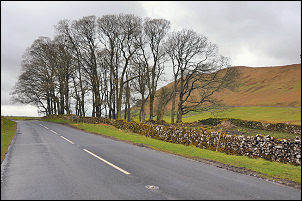
 This was the track my SatNav tried to send me down! |
||||||||||||||||||||||||||||||||||||||||||||||||||||||||||||||||||
 Wesleyan Methodist Church |
|
||||||||||||||||||||||||||||||||||||||||||||||||||||||||||||||||||
|
|
At the bottom the track I joined the main A683 where I crossed at the Wesleyan Methodist Church and headed up the lane to Sprintgill. It was still quite windy as I continued across Murthwaite Rigg to Murthwaite Farm. I was heading down to Wandale Beck but the path was very wet after the overnight rain. When I reached the beck the ford was quite deep so I had to take my boots off and wade across. As I dried my feet I noticed a small concrete bridge in the adjacent field which I couldn’t see marked on my map. I joined the access road up to Narthwaite but I couldn’t see anyone about. |
||||||||||||||||||||||||||||||||||||||||||||||||||||||||||||||||||
|
I followed the stony track towards Wandale Hill then took the muddy path along the east side of Wandale Hill to the ruin of Wandale. It is certainly a place with difficult access and is hard to imagine while a house would be built here in the first place. There is another group of ruins nearby and the 1851 mentions both but doesn’t explain which is which.
|
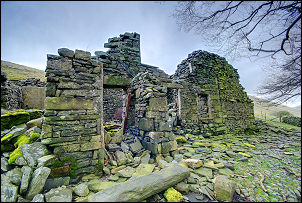 Wandale ruin. |
||||||||||||||||||||||||||||||||||||||||||||||||||||||||||||||||||
|
I took a direct line up the fell and wandered over the featureless Wandale Hill. There is no cairn to mark the summit an as the top is fairly flat it would be difficult to know where to build it. I descended to the NE and came across what looked like some old mine workings but nothing is marked on the map. I descended to the track where some wall re-building had been done since I was last here. I passed through Adamthwaite farm but nobody was about. Following the tarmac road for a while I left it to head up Harter Fell. The first part of the climb was steep but I came to an old track which followed more sensible route on to the fell top. I reached the summit cairn but didn’t hand about as it was very windy and the rain began to increase. I descended down Hartfell Brow then a steeper line to the wall and Sally Beck. I reached the main A683 again and crossed over to take a short cut through the field to the old road. On the way I came to a recent excavation down an old pothole which was being dug out and temporarily capped while the cavers were away. I followed the road for a while before leaving it to head back down to the A683 at Studfold. I followed the main road and returned to my car back up the rough track at Dovengill. |
|||||||||||||||||||||||||||||||||||||||||||||||||||||||||||||||||||
|
|
I called in at the Cross Keys at Cautley for a pot of tea. I chatted to the proprietor who is a Quaker. He told me he was the one who looked after the Quaker Burial ground where I’d parked my car and also told me site of the old Fell End Meeting house which I then called at on the way home. |
||||||||||||||||||||||||||||||||||||||||||||||||||||||||||||||||||
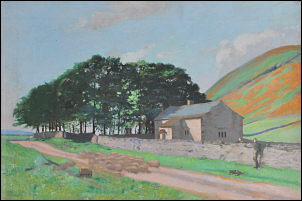 A painting of the Old Quaker Meeting House, Fell End, Ravenstonedale c1895 (built 1705) by Edith Adelaide Hewetson (1868-1948) |
|
||||||||||||||||||||||||||||||||||||||||||||||||||||||||||||||||||
|
Fell Head Meeting House Aug 1924 (right) The now functioning hinges on the door of K. S. (Kirkby Stephen) Meeting House were taken from Fell End Meeting House. F.W.P's note pencilled on the back of the card states; "W. Tunstead took the stones away, to build a field-house." |
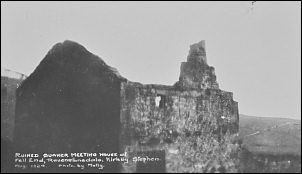 Ruined Quaker Meeting House, Fell End, Ravenstonedale Aug 1924 |
||||||||||||||||||||||||||||||||||||||||||||||||||||||||||||||||||
|
Additional notes: Quakers and dissenters "The term Dissenter refers to a number of Protestant denominations -- Presbyterians, Baptists, Quakers, Congregationalists, and others -- which, because they refused to take the Anglican communion or to conform to the tenets of the restored Church of England in 1662, were subjected to persecution under various acts passed by the Cavalier Parliament between 1661 and 1665. Examples of the attempts which were made to discourage them were the Act of Uniformity, which required all churches in England to use the Book of Common Prayer, and punished those who would not comply, and the Five Mile Act, which prohibited ministers who were ejected because of the Act of Uniformity from coming within five miles of their former parishes or of any town or city. After the Toleration Act was passed in 1689, Dissenters were permitted to hold services in licensed meeting houses and to maintain their own preachers (if they would subscribe to certain oaths) in England and Wales. But until 1828 such preachers remained subject to the Test Act, which required all civil and military officers to be communicants of the Church of England, and to take oaths of supremacy and allegiance. Though this act was aimed primarily at Roman Catholics, it nevertheless excluded Dissenters as well." ===== A toll bar stood here between 1762, when the current A683 was constructed, and 1874, when the maintenance of the road was vested in the County Council. The house was then offered for sale for £50, but there seem to have been no takers, and nothing now remains. A Quaker Meeting house formerly stood just to the north of the toll gate. Dr. Thomas Gibson says, "Close by the road to Sedbergh, at Fell End, in what appears to be a compound of old school houses and barn, but a portion of which is really an ancient Friends' Meeting House. Just within the gate, to the left on entrance, without memorial stone or anything to mark the spot, lie the remains of several friends who have been interred here. It is a lonely, neglected place." http://freepages.genealogy.rootsweb.ancestry.com/~davie/FellEnd/Quakers.html 1713 5 October. On a petition to Quarter Sessions by the people called Quakers desiring to have a barn in Ravenstonedale for a place of meeting for religious worship; it appeared to the Court that the same would be a great disturbance to the church, the place being near adjoining thereto, and it also appeared that the said people called Quakers have already a convenient place set apart and licenced in the parish, it was therefore ordered that the petition be refused. http://www.british-history.ac.uk/report.aspx?compid=43514 ==== Firbank Knott near Sedbergh is considered to be the birthplace of Quakerism as it was here, in 1652, that George Fox gave his great sermon to inspire over a thousand 'seekers' from the whole of the north of England. The Quaker Meeting House at nearby Brigflatts is the oldest in the north of England. The Meeting House in Fell End, Ravenstonedale was built in 1705 and later a burial ground was added which was in use between 1739 and about 1838. Previously meetings had been held in Friend's houses, although there was an earlier Meeting near Dovengill with an adjoining burial ground first used in 1659. For some unknown reason, in about 1793 the Meeting moved to a smaller meeting house at Narthwaite, though the Fell End Meeting House remained standing until 1899, when it was demolished. It was described as "a place of pleasing and simple appearance externally, with fine woodwork inside, and turned oak balusters to the loft" (The Friend 1893, 249) http://www.adamthwaitearchive.org.uk/#/quakersanddissenters/4531765454 |
|||||||||||||||||||||||||||||||||||||||||||||||||||||||||||||||||||