|
Last night the rain eventually stopped
and the night was calm. There was still no rain as I packed the tent
up but the sky was unbelievably dark and menacing. It was definitely
a case of when, not if, it would be raining again. I’d been on the
road a few moments when the rain started. Light at first then soon
it was torrential. Wherever I could I tried to get a few seconds
shelter under overhanging trees, but seconds is all it was. The
menacing dark skies showed that the rain was set. I pressed on up a
steep climb through Midlem and on to the A699. Being a Sunday
morning I didn’t expect to see many cars and it turned out that
after 2 hours of riding I’d seen one. I turned left at the A699 road
and headed for Selkirk. The rain fell in torrents and I felt sorry
for the few people I saw out walking and even a few cyclists. The
town centre of Selkirk looked interesting but there was nowhere to
shelter so I had to press on. I joined the A707 towards Innerleithen
but my original plan was to join the minor road south of the river.
As there was little traffic on the road and the rain continued in
torrents I decided to keep to the main A72. It would have been a
delightful ride if the rain hadn’t continued. In Innerleithen. |
|
I turned north along the B709. It
looked interesting on the map but not as good as it turned out to
be, in spite of the rain. Less than a mile along the road a cyclist
overtook me, commenting on my panniers of ‘supplies’. The rain
increased and about a mile ahead he turned round and headed back,
presumably thinking that cycling in the rain was not a good idea.
The road passed through the local golf course and it’s interesting
to see that the rain didn’t put off golfers. The road turned out to
be a delight to ride along, even in the rain. There was a long
steady climb but no difficulties. |
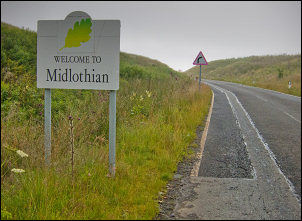
Midlothian through the Moorfoot Hills |
|
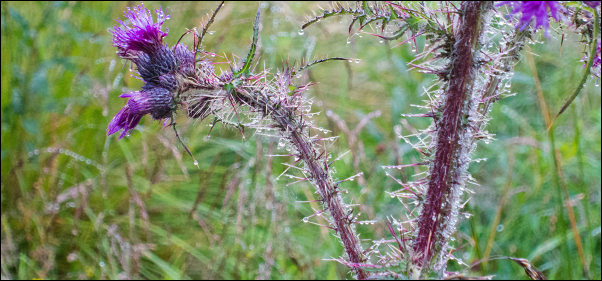
Scottish Thistle in the rain |
|
A similar descent was followed with
another climb which had the added bonus of no rain. I was surprised
at the amount of road engineering that had taken place. A deep
cutting had been used to provide the fill for a similar deep
culvert. I stopped on the summit to see the Midlothian boundary sign
before starting my descent. The lack of rain was soon rectified. The
long descent was accompanied by light rain, then a torrential
downpour. I saw 2 cyclists coming up the other way and felt very
sorry for them. Approaching the A7 at Middleton I was past caring. I
was soaked through and needed to keep going to keep warm. I turned
left and was surprised to meet a dry road. The ride to Gorebridge
was dry all the way and it seemed so strange after the hours of rain
I’d been riding through. I reached the small town and stopped at the
shop to see if bottled water was available. I was at almost 3 times
the cost of Jedburgh. |
|

The old ruined parish church of Cockpen near Bonnyrigg |
|
I decided not to bother and hopefully
continue to a petrol station where I could find a tap to top up the
2, 2lt containers I was carrying. No sooner had I walked out of the
shop than the rain started. I wheeled the bike across the road to a
bus shelter to let the worst pass over. The deluge was
indescribable. Within seconds the road was completely awash and the
bus shelter was so deep in water I had to sit on the grubby metal
seat and hold my feet off the ground. It was a long time before the
main downpour subsided and even then I didn’t get far before the
next one hit. I took refuge in the village toilets and took
advantage to fill my water containers. A set off again but only got
as far as the Library before having to take shelter again. The
Library entrance had a covered area which made an excellent refuge. |

Old gravestones at Cockpen Church |
|
I noticed a mown grass area beside the
Library and decided to pitch the tent. It was very close to the path
but in the circumstances it was any port in a storm. By late
afternoon the rain had stopped and people were starting to make
puzzled looks at my tent. I decided to move and packed up and set
off north. To the left The old ruined parish church of Cockpen near
Bonnyrigg with a well maintained graveyard. The grass had been mown
and it was an ideal and quiet spot to camp. I camped by the plot of
the Marquess of Dalhousie (1812 – 1860). |
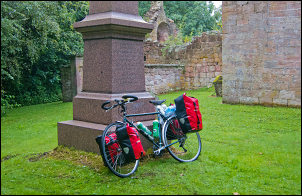
Grave of the Marquess of Dalhousie
(1812 - 1860) |
|
 |
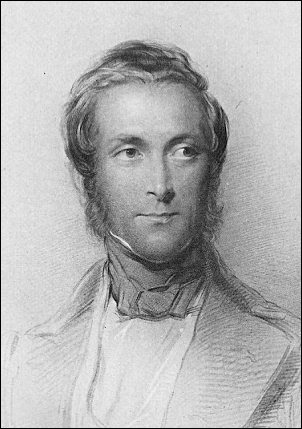
Marquess of Dalhousie (1812 - 1860) |
|
James Broun-Ramsay,
1st Marquess of Dalhousie (1812 - 1860)
He was a Scottish statesman, and a colonial administrator in British
India.
Portrait of Lord Dalhousie
by John Watson-Gordon, 1847. |
|
|
 Return to
Whittle Wanderer
Return to
Whittle Wanderer