|
It was a clear night and the temp
dropped to 5 degC. Some parts of the country were able to see a
meteor shower but I was camped under a very leafy tree so couldn’t
see much of the sky anyway. The back tyre wasn’t completely flat so
I pumped it up to see how far I could get on it. I set off at 07:55
under a chilly blue sky. There was no wind yet so the riding was
very enjoyable. |
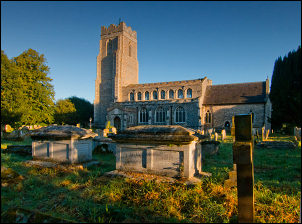
Sunny morning at the Church of the Holy Innocents |
|
After about 3 miles the back tyre had
gone down so I found a sunny spot to stop and change the inner tube.
I was surprised to find a very long and thick thorn had gone through
the tyre and about 4mm into the inner tube. How I got about 8 miles
each pump up was amazing. I was on my way again and the tyre stayed
up. In the delightful village of Woolpit was an interesting Queen
Victoria Jubilee memorial. |

Woolpit - forever England |
|
Unlike the stone structures I’d seen
previously this was made of wooden over a manual lever water pump.
Wooden carvings of previous queens were around the outside. I
reached Stowmarket and before I knew it was out of the other side.
Apart from the Memorial Gates there was nothing memorable or
photographic to stop for and as I continued couldn’t remember a
single redeeming feature of the town. |
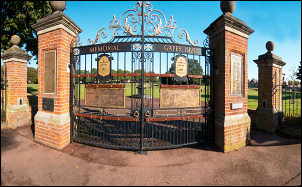
Stowmarket, 1920 Memorial Gates |
|
For a while the road was uncomfortably
busy but after crossing the A140 things seemed to quieten down a
bit. I was on the A1120 and looking forward to reaching Saxstead
Green and turning off towards Framlingham. Through Framlingham were
several signs pointing to the Castle but I didn’t top in the town
but had a brief stop on the way out to nibble some biscuits. I
continued to Saxmundham and found it the busiest and liveliest town
I’d been through so far. A new Tesco store was on the right so I
stopped in the warm sunshine to buy some water and a pack of
biscuits. Riding along the B1119 the sun left and so did the warmth.
In Leiston I smelled the delicious aroma of chips and couldn’t
resist stopping at the fish and chip shop for chips. |
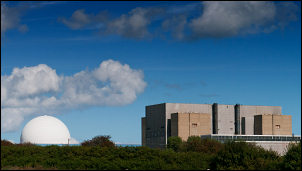
Sizewell Power Stations |
|
They were excellent and came in a
proper brown paper bag which the chips didn’t stick to. The
greaseproof bags I usually get chips in tend to stick. These details
are important so well done Leiston chippy. I wanted to see the power
stations at Sizewell and hadn’t gone far before the white dome of
Sizewell B appeared in the distance. It was too far off my route to
go right up to the buildings but I got close enough. |
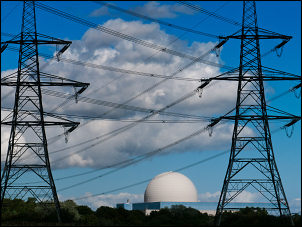
Sizewell B |
|

Leiston Abbey |

Leiston Abbey |
|
The road north went
past
Leiston Abbey, which was founded in 1182, and I could see the
ruins across a field. I couldn’t resist making the detour to wander
around the magnificent ruins. The amazing thing is it was all free
and I had the whole place to myself. |
|
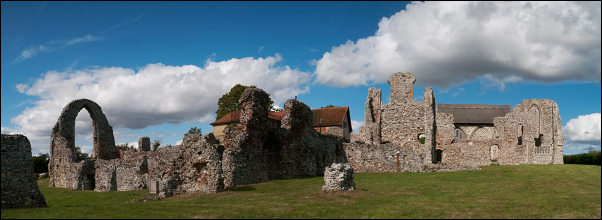
Leiston Abbey |
|

Middleton guardian |

The Middleton guardian |
|
Riding on I was approaching Middleton
when I saw the sort of innovation by the road that always makes me
smile. There was a larger than life shiny steel cowboy with 6
shooters drawn in a menacing manner. The detail in the statue was
excellent with bicycle chain on the spurs, which were a bike rear
sprocket, and facial stubble spot welded on. This beats flowers in
hanging baskets which are nice but far from original. |

The spurs |
|
I picked up a signpost to
Dunwich, my last objective of the day. On the final approach to
the village is the entrance gate to the ruined Priory. I had a quick
look but as I intend returning shortly didn’t spend much time there.
Down the hill is the car park and refreshment building but the true
gem is the Museum along the main street. A £1 donation is all that
is asked for to get in. |

Dunwich Museum |
|

All Saints Church before falling into
the sea |

All Saints Church around 1903 |
|

Dunwich, Suffolk c. 1830 by J.M.W.Turner |
|

The St Elizabeth Flood of 1570 |
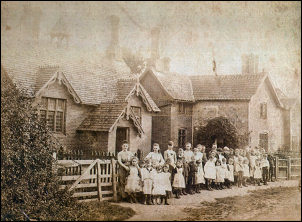
Schoolchildren in Dunwich |
|

Members of Parliament for the Borough of Dunwich
|
As a legacy of its
previous significance, the parliamentary constituency of
Dunwich retained the right to send two members to Parliament
until the Reform Act 1832 and was one of Britain's most
notorious rotten boroughs. |

Blackadder the Third |
|
Dunwich is
satirised in an episode of the British television show
Blackadder the Third titled 'Dish and Dishonesty'. Named
Dunny-on-the-Wold, it has a population of three cows, a
dachshund called `Colin', and "a small hen in its late
forties"; only one person lives there and he is the voter.
After an obviously rigged election (in which it is revealed
that Blackadder is both the constituency's returning officer
and voter, after both died in highly suspicious
"accidents"), Baldrick is made an MP having received all
16,472 of the votes cast.
Many thanks to
Wikipedia for the above 'Rotten Borough' and Blackadder
information. |
|
|

Greyfriars Priory entrance gate |

Greyfriars Priory |
|

Wide view from the cliffs above Dunwich looking east to the
North Sea.
In the 14th century there was a further 1.5km to the seashore. |
|
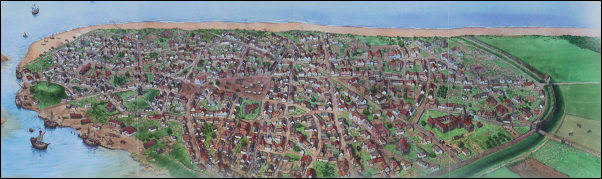
Artist's impression of the same area in the 14th century |
|
There was an incredible model of the
medieval town of Dunwich which has all been reclaimed by the sea.
Only the Priory ruin remains. Old photos of All Saints Church were
on display as a series over time, showing how the sea had nibbled it
away bit by bit. The last buttress was rescued and rebuilt in the
current church graveyard. I returned to the Abbey and wheeled my
bike towards the sea cliff edge. There is a path and a wall but the
wall will go over the side when the next storm hits. I narrow strip
of overgrown thicket is all that remains of All Saints Graveyard. |
|
There is a grave stone visible and
another smaller one close bye. In the SE corner was a piece of rough
land between a fence and the wall and wide enough to get my tent in.
Better still was a short unofficial path to the cliff edge giving a
clear view out to sea and the area that was once a huge medieval
town of major importance. It’s the ultimate illustration of how
man’s power is nothing compared with nature. It will be interesting
to see if the man’s remains in the last grave are moved to the
current church before nature uproots his bones and rolls them down
the cliff and into the sea. I managed some late afternoon sun on the
tent before the sun dipped below the trees to the south. The nights
are approaching at their fastest as today is the Autumnal Equinox. |

The last gravestone is of Jacob Forster
who died in the late 18th Century |
|
|
 Return to
Whittle Wanderer
Return to
Whittle Wanderer