Boyd's photo diary. |
|
|
|
|
|
|
|
|
Tue 29 Nov 2011
|
Recently the
tell-tale streaks of rust coloured liquid running down the left
crank indicated the bottom bracket bearing had failed. I removed
the crank and my suspicions were confirmed. The right bearing
was still running perfectly so the left bearing failure must
have been just bad luck. It had done just under 9,000 miles. I
managed to pick up a replacement from Paul Hewitt cycles in
Leyland and found the replacement process fairly
straightforward. The bearings were helpfully marked left and
right and also the thread direction as each side has a different
thread orientation. |

the tell-take streaks of rust oozing from the bearing indicate
they are worn out |
|

the bearing shell about to be remove |

a shiny new set of bearings are fitted |
| |
|
|
Thu 24 Nov 2011
|
On Thu 24 Nov
2011 Lizzie Jones made a very welcome return to Astley Hall to
give her presentation ‘Mary Queen of Scots’ covering the life of
Mary Stuart from her birth in 1542 at Linlithgow Palace,
Scotland to her imprisonment at Tutbury Castle near Derby. The
event was organised by Chorley Historical and Archaeological
Society who have been arranging annual visits to Astley Hall by
Lizzie for many years.
Astley’s Great Hall was filled to capacity as Lizzie, dressed as
Mary Stuart Queen of Scots, gave a captivating and moving
monologue of her life so far.
She assumed the position of Mary after 15 years of captivity and
currently imprisoned in the cold and uncomfortable Tutbury
Castle.
The life of Mary was filled with tragedy and political intrigue.
Her father King James V of Scots died 6 days after Mary was born
and Mary subsequently became Queen Mary I, Queen of Scots. To
protect her from various political plots she was taken to France
to marry Francis II, son of the King. The following year in 1558
the King died so Francis became King and Mary the Queen Consort
of France. Sadly Francis died in 1560 so Mary returned to
Scotland in 1561. She was still Queen of the Scots and proceeded
to try and unite the various factions in her country. |
|
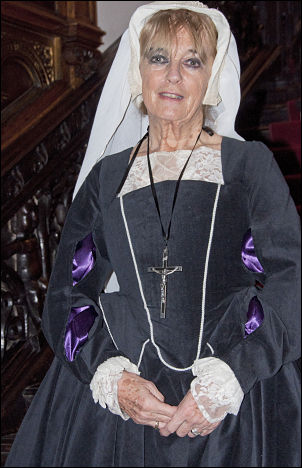
Lizzie Jones at Astley Hall as Mary Stuart |

Mary Queen of Scots while in captivity.. |
|
At the same time the English throne was occupied by Queen
Elizabeth I and Elizabeth was concerned by an earlier claim to
the English throne by Mary, who was her cousin. Another major
concern was that Mary wanted to return the English Protestant
Church to the Roman Catholic faith. Mary’s Roman Catholic faith
stayed with her all her life but she always said she had no wish
to impose in on England.
In 1565 Mary married Henry Stuart also known as Lord Darnley.
The marriage was not a success but they had a son James who
eventually became King James VI of Scotland and on the death of
Elizabeth I of England became King James I of England in 1603.
King James visited the Chorley area in 1617 when he visited
Hoghton Tower.
Political intrigue continued in Scotland and Mary was imprisoned
in her own country. She managed to escape to England in 1568,
hoping that her cousin Elizabeth would help her to return to
Scotland. Unfortunately the only reception she received was 19
years imprisonment in various castles and houses culminating in
her execution at Fortheringhay Castle in 1587.
Her execution was as a result of a shady conspiracy called the
Babington plot. This is where another Chorley link was pointed
out.
In 1586, a man called Anthony Babington devised a plot to kill
Elizabeth, rescue Mary and then see her as the next Queen of
England. The plot was real but it is debatable whether Mary knew
of it.
Queen Elizabeth’s spies found out about the plot and Babington
and his associates were tried, found guilty and executed in
September 1586. One of Babington’s associates was Chorley’s own
John Charnock (1551 – 1587). He was executed on 21 Sept 1586.
Mary was also tried, found guilty and executed on 8 February
1587. One of the consequences of the dubious trial and
execution was the anger felt in Catholic countries, especially
Spain. The following year in 1588 King Philip II of Spain sent
his Spanish Armada to invade England and hopefully remove
Elizabeth from power. The attack failed and England remained
under the reign of Elizabeth.
|
|
= = = = = = |
|
This afternoon
walked to Shaw Hill Gold Club to give blood. I was last here in
July but this time it was more interesting as instead of lying
on a flat table there were reclining seats. Apparently they are
more efficient to operate as they stack together for
transportation and make access for the staff better. Also the
patient can now see what’s happening, if they want to. I could
watch the nurse connection the pipe up and see that two pipes
run out from the main one. One is to take an initial sample for
analysis, and take the first ‘flush’ of blood which contains
skin cells from the needle. The second pipe goes in to the
receiving bag. The bag is weighed electronically and it’s
possible to see the progress as half a litre is taken. I’ve
donated blood 33 times. |
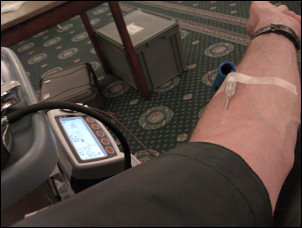
the New tilting seats means its possible to see what's going on
as the blood drains away |
|

Instead of the old 'Operating Tables'
patients are now sat in tilting seats |

I was handed an overdue badge for being a blood donor. I'm now
way past 25 donations. |
|

A rather posh location for donating blood,
this is Shaw Hill Gold Club. |
|
Wed 23 Nov 2011
|
I was out on a
walk round the plateau of Kinder Scout in Derbyshire. I saw an
interesting rocky feature and thought it would be a good subject
to take comparison photos on my Panasonic camera and HTC mobile
phone. By modern standards its an old phone and low level camera
specification but it still impresses me. I've applied HDR (High
Dynamic Range) software in each case to the single exposure. |
|

Taken on my HTC Wildfire mobile phone |
|

Taken on my Panasonic GH1 camera |
|
Tue 22 Nov 2011
|
Last week I
started using my son’s old phone as he’s got a new one. It has
many more bells and whistle than my old basic one. I was out for
a cycle ride via Belmont and Bolton and on the way stopped by
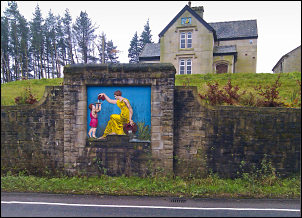
one of the reservoirs to take these pictures on the phone’s
camera. I was quite impressed the quality that it produced.
While riding I had the phone’s GPS track recording facility
switched on so when I got home I could transfer the gpx file to
the PC and see exactly where I’d been, the altitude profile and
how fast I was going. |
 |
|

taken on my new (second hand) HTC
Wildfire phone |
|
Sat 19 Nov 2011
|
 |
|
I'm a sucker
for wide views and can't resist taking several shots to merge
later. This view of the Lune valley shows the Howgill fells in
the distance. Below is the River Lune and vehicles can be seen
travelling on the M6 motorway |
|
Sun 13 Nov 2011
| Today
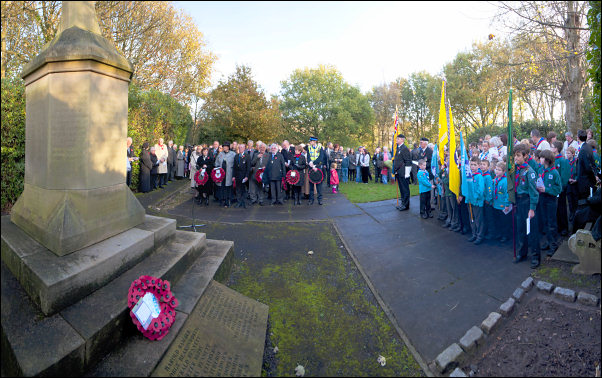
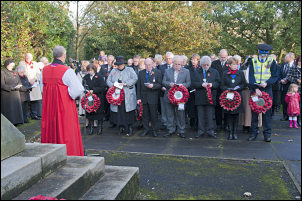
I attended two armistice memorial services. The first was at
12noon in Withnell Fold. Then it was back to Whittle for the
Whittle and Clayton service at 2:30pm |
|
Below are the
Whittle and Clayton photos |
 |
 |
 |
|
The memorial
service started in the playground of St John's School then
walked to the memorial. This photo was taken when walking back. |
 |
| |
|
Below are the
Withnell Fold photos |
|
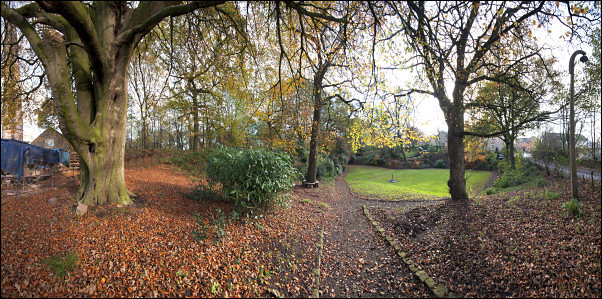
Before the memorial service I took this wide view photo of the
memorial garden. |
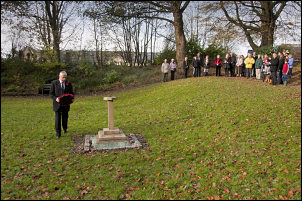
Peter Mallon places a wreath on the Withnell Fold memorial |
 |
|
The photo on
the right was brought to the service by the soldiers grandson.
The soldiers name was L/cpl. Thomas Chadwick and he died on 25
March 1918. The numbers of soldiers who enlisted and subsequent
casualties for Withnell Fold Paper Mill are as follows:
| |
Enlisted |
Killed |
| WW I |
83 |
14 |
| WW II |
66 |
5 |
| |
149 |
19 |
|

L/cpl Thomas Chadwick |
|
Sat 12 Nov 2011
|
 |
|
Today was one the Withnell Fold
work days in the Memorial Garden. This composter was built by
David Birtill. |
|
|
|
|
This evening
caught the bus to Finnington Lane, Hoghton and walked home along
the canal. There was a nice moonrise. |
 |
|
Fri 11 Nov 2011 (11/11/11)
|
Today is unique
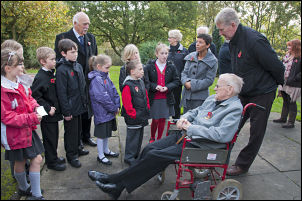
as it is the Armistice day with the date of 11/11/11 at 11am. At
the Whittle and Clayton Cenotaph for the 11 am two-minute
silence were several pupils form the adjacent Whittle-le-Woods C
of E Primary School and also Bill Ramsbotham, a WW11 veteran who
saw action in North Africa and Solerno in Italy. The children
had several questions for Bill as they were interested in his
war memories. One of the many questions was ‘what did you eat?’
to which Bill replied ‘we sere sent ration boxes which contained
tins of corn beef and other canned items. One thing we
particularly looked forward to were cigarettes, but usually
these had been liberated from the ration boxes before we
received them’. Bill’s friend Frank Riley was with him during
the Italy campaign but unfortunately Frank was killed in action
and never came home. His name is now on the memorial where the
two-minute silence took place. |
 |
|
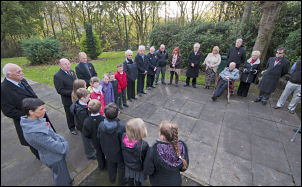
observing the two-minute silence |
|

Pupils of Whittle-le-Woods C of E School, Bill Ramsbotham
(seated) and Cllr Eric Bell |
|
Tue 08 Nov 2011
|
 |
|
This evening I
caught the bus to Chorley. While at the Bus Station I thought
I'd better take a photo of the information board while we still
have it. It is quite unbelievable that Lancashire County Council
are going to switch it off next month to save money. If you want
to stop people visiting Chorley and stop using the bus service
this is one of the ways you can do it. LCC must be bonkers. |
|
Tue 01 Nov 2011
|
Yes I know
they're just another couple of sunsets but when I'm out cycling
I always get the urge to to snap them when a nice one is
visible. These were taken looking west across Anglezarke
Reservoir. |
 |
|
 |
|
|
|
